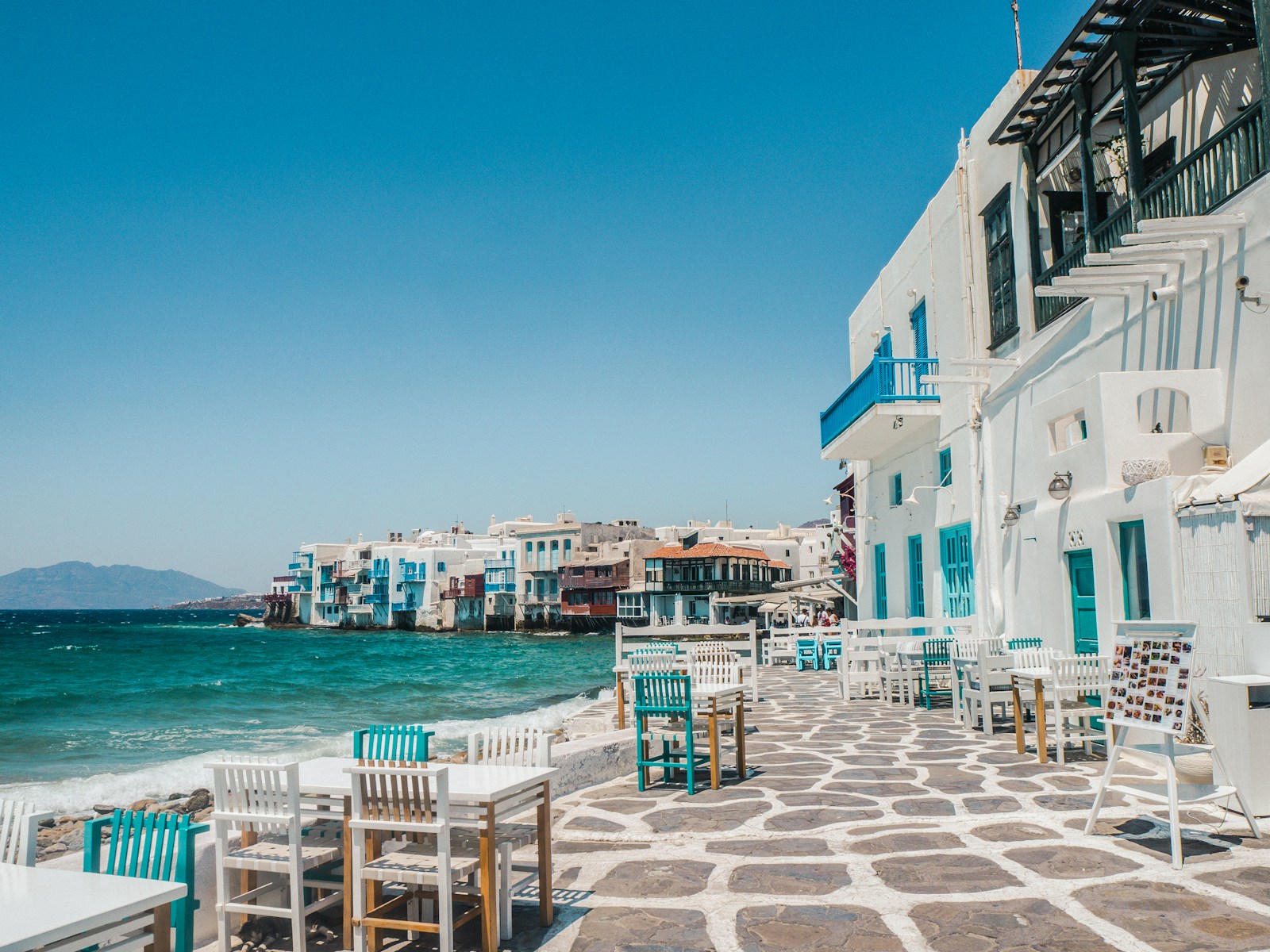
Picture, for a moment, a morning on Mykonos in July. You step out of an air-conditioned villa onto a white terrace that is already warming under your bare feet, and below you the bay of Psarou is starting its day, the music drifting up from the beach club a kilometre off, the small boats coming in to anchor for the long afternoon. It is the Greek-island morning a million people have imagined themselves into, and once you are inside it, you understand why.
Now picture, for the same moment, a morning on Folegandros. You step out of a small whitewashed house onto a terrace cut into a cliff two hundred metres above the sea, and there is no music. There is the sound of a goat bell carrying for half a kilometre across the rock, the small clatter of an ageing fishing caique somewhere out on the water, the quiet of a chora village whose seven hundred year-round residents are mostly still asleep. The bougainvillea on the wall behind you has been doing its violent pink thing for three months and will keep doing it until October. You can hear the cicadas in the wild thyme. You can hear yourself think.
Both mornings are the Greek islands. They are also, arguably, two different countries. The question this article is going to answer, with as much honesty as it can manage, is which one is yours, because the famous islands and the unfamous ones have diverged dramatically in the last decade, and most articles still cover the famous ones as if nothing has changed.
The quick answer
Read the lines below and notice which one your eye returns to.
- Choose Paros if you want the best balance of famous-but-not-overrun, beautiful villages, swimmable beaches, and good food, with no major architectural disappointment.
- Choose Milos if you want the most dramatic landscape (volcanic cliffs, white-rock coves, the lunar coast around Sarakiniko) and you do not need a developed nightlife.
- Choose Santorini if the caldera view is non-negotiable, you accept the crowds and the prices, and you want the postcard everyone has already seen.
- Choose Mykonos if the social scene is part of the holiday, money is not the constraint, and you have made your peace with the fact that the island is busier than it used to be.
- Choose Folegandros, Tinos, or Andros if you have been to the Cyclades before and want the islands the way they used to be.
- The honest tiebreaker: for a first Greek-islands trip, Paros is the right answer six times out of ten.
You will already be leaning. Hold that lean. The next sections will either confirm it or quietly redirect you toward the island you should have been considering all along.
The famous islands
Mykonos
Mykonos in the right week is still the island the magazine covers promised: whitewashed villages, the pure Cycladic architecture that has been copied across half the Mediterranean, a brown-rock landscape that reads as theatre at any time of day, and a beach club culture that defined the European summer for two decades. The town, called Chora locally, is genuinely beautiful, especially at dawn before the cruise traffic starts moving and the windmills throw their long thin shadows across the water. The beaches still work, particularly Agios Sostis on the north coast where the music from the south coast cannot reach, and the food at the high end has improved meaningfully in the last five years. The honest read is that Mykonos in July and August is one of the most expensive and crowded places in Europe, full stop, and Mykonos in May, June, or late September is a different island that is worth visiting on its own terms.
The villa stock concentrates in three areas. Agios Lazaros is closest to town, walkable for dinner. Elia is beach-focused and family-friendly, the calmer southern alternative to the south-coast clubs. The deep north is the quietest, with the most dramatic coastline and the longest drives but also the kind of evening peace the rest of the island has lost. The boutique hotel option is excellent here, with Belvedere, Cavo Tagoo, and Bill & Coo as the institutions.
Plum Guide's Mykonos collection is the cleanest entry point for villas. For boutique hotels, Mr & Mrs Smith's Mykonos curation is stronger than Booking.com's, with the partner perks worth the small differential. For broader villa inventory, search Booking.com and filter by neighbourhood.
When to go: late May to mid-June, then mid-September to early October. July and August are punishing. October is genuinely lovely if you can swim in nineteen-degree water.
Santorini
The caldera view is real, and nothing in any photograph quite prepares you for it on first sight. The villages on the rim, Oia and Imerovigli and Fira, are stacked into the cliff in a way that looks accidental and is in fact the result of three and a half thousand years of architectural adaptation to a volcanic landscape that has periodically destroyed everything humans tried to build on it. The rest of the island is volcanic and dry, with black-sand beaches that are striking but are not the right reason to visit. The honest read is that Santorini is the most over-photographed island in Greece, and yet the place itself still works on first sight in a way that almost no other destination does, the silhouette of the caldera at sunset doing exactly what the postcards promised even though you arrived prepared to be unimpressed. The crowds in peak season are the price you pay, and the price is real.
The villa stock falls into two registers. The cliff cave-house in Oia or Imerovigli is the postcard, expensive, often very small in actual square metres because the cave format does not lend itself to large rooms. The inland village pool villa, in Megalochori or Pyrgos or Emporio, trades the view for square footage and a more authentic Santorini, the agricultural side of the island that almost no first-time visitor sees. For a first trip, choose the caldera. For a return trip, the inland villages are the better answer.
The Mr & Mrs Smith Santorini collection skews toward the boutique caldera-view properties and is the cleanest entry point. For private villa rentals, Plum Guide's Santorini listings are growing. Booking.com carries the wider field.
When to go: April and May for cool but stunning weather, before the crowds, then mid-September through October for warmer water and fewer cruise ships. July and August are unmanageable in Oia.
The rising islands (the Route Style picks)
Paros
Paros is the Cycladic island that gets it right, and the longer you stay the more clearly you understand why almost everyone who has visited returns at least once more. The villages are beautiful without having been curated for tourists. Naoussa, the harbour town on the north coast, has a small port lined with old fishing boats and a network of white-painted lanes that open suddenly onto small squares with single tables under bougainvillea. Lefkes, inland, is the marble-paved mountain village where Byzantine churches sit on streets so narrow that a donkey is still the most efficient form of transport. Parikia, the port and the working town, has the Panagia Ekatontapyliani, one of the oldest functioning churches in Christendom, and a rhythm that has nothing to do with the harbour ferries arriving and leaving. The beaches range from sandy and developed (Golden Beach for kitesurfers) to wild and empty (Kolymbithres with its sculpted granite, Faragas, Tsoukalia), and the food is genuinely strong. The Naoussa harbour restaurants are not the trap they look like, and the inland tavernas in the mountain villages are the kind of evening that an island can quietly turn into a memory. Paros has been the next-Mykonos for ten years and has somehow not let it go to its head.
The villa stock divides into three sub-areas. Naoussa and around is the most developed, walkable, and restaurant-heavy. The south coast, around Aliki and Drios, is the quieter beach-villa zone. The inland villages, particularly Lefkes, are where you find small family-owned villas in olive groves with a fifteen-minute drive to whichever beach matches your mood that morning. The villa stock is significantly larger than Santorini's, and prices are thirty to forty percent lower for comparable quality.
Plum Guide's Paros collection leans toward Naoussa and the south coast and is the strongest curated entry point. For the inland village villas, Booking.com has the wider field, often listing properties owned by Greek families that have not reached the curated platforms.
When to go: May, June, and September into October. July and August are busy but the island absorbs the crowds better than Mykonos. Easter is a special week in Greece if you have any interest in the religious processions, with the candlelit midnight liturgy in Lefkes being one of the most quietly moving evenings the Cyclades has to offer.
Milos
Milos has the most dramatic landscape in the Cyclades, and that sentence does not quite cover what the landscape actually does to you on the first afternoon. The volcanic origin shows everywhere: white pumice cliffs at Sarakiniko that genuinely look like the surface of the moon, red iron-rich sand at Paliochori where the heat from underground still warms parts of the beach, and a coastline of caves and arches and small coves best explored by boat from Adamantas harbour. The villages are smaller and quieter than Paros. Plaka sits high on the rim of the old caldera and is the right place for sunset, with a single small church on its highest point that has been the postcard of Milos for thirty years. Pollonia, on the north coast, is the harbour village with the better restaurants, where the catch comes in at six in the evening and ends up on the table by eight. Milos is what travellers picture when they think "undiscovered Greek island," and the discovery is happening at a pace that makes returning visitors slightly defensive about it. Rates have nearly doubled since 2021.
The villa stock is small but growing. Most properties are in or around Plaka, Pollonia, or the south coast near Provatas and Firopotamos. Boutique hotels lead the inventory here more than private villas, with Skinopi Lodge, Milos Cove, and Salt of the Earth as the high-end anchors.
Mr & Mrs Smith's Milos collection covers the boutique hotels well. For private villa rentals, Plum Guide's Milos listings are the cleanest curated set, and Booking.com has the broader range.
When to go: late May through June, then late September through early October. Milos peaks slightly later than Mykonos because the wind, which is the underrated logistical factor in the Cyclades, is calmer in September.
Naxos
Naxos is the largest Cycladic island, and the most agricultural, and the answer for travellers who want the Cycladic landscape without the Cycladic vacation atmosphere. Where Paros has been quietly curated over the last decade, Naxos is still genuinely working. Olive groves, mountain villages where people farm rather than rent, beaches that go on for kilometres (Plaka beach is one of the longest sand beaches in Greece). The chora is real and walkable and not arranged for the cruise market, the Portara (the marble doorway to a temple of Apollo that was never finished, standing alone on its small islet at the harbour) is the Cycladic icon nobody outside Greece talks about, and the food is the strongest in the Cyclades for travellers who like meat and cheese, since Naxos's interior produces both at a level the smaller islands cannot match.
The villa stock concentrates in the chora and the south-coast beach villages. The contrarian pick is a mountain village villa in Halki or Filoti, set in olive groves with a twenty-minute drive to the sea, the kind of inland Cyclades stay that almost nobody plans for and almost everyone enjoys more than they expected.
Plum Guide's Naxos collection is the curated entry point. Booking.com's Naxos search catches the full field, including the inland villages.
When to go: the Cyclades pattern. Late May into June, then September through October.
The deep cuts (for return visitors)
Folegandros
A small Cycladic island, two hours by ferry from Santorini, with a single chora village and a few coastal hamlets along its coastline. The chora sits on a two-hundred-metre cliff and is one of the most beautiful villages in Greece, the kind of small white-on-white settlement that has been used in films and paintings for fifty years and still looks better in person than in any of them. The island has seven hundred year-round residents, no airport, no significant nightlife, and a pace that makes Mykonos feel like Manhattan. The beaches are reachable by boat or a long walk, and the long walk is part of the point. The food is simple and excellent. Folegandros is the trip that makes you want to come back rather than the trip that makes you want to go everywhere.
The villa stock is genuinely small. The boutique hotels (Anemi Hotel, Anemomilos Apartments) are the easier first booking and the right answer for first-time visitors.
Booking.com's Folegandros search is the right tool here, since the curated platforms have not reached the smaller properties yet.
When to go: June and September.
Tinos and Andros
The Cyclades' two contrarian picks, and a pair of islands that almost no English-language guide covers properly. Tinos, just thirty minutes north of Mykonos by ferry, is the religious island, with one of Greece's most important pilgrimage churches (the Panagia Evangelistria) and a network of mountain villages whose architecture has been almost untouched by tourism. The marble-carving tradition here is the strongest in Greece, and the small museums in the inland villages are quietly some of the best-curated cultural spaces in the Cyclades. Andros, further north and closer to Athens, is the green Cycladic island, with more rain, more walking trails, mountain villages, and the Goulandris museum, a remarkable contemporary art collection that almost no first-time Cyclades visitor knows about. Both islands are ninety percent domestic-tourist destinations, which means the food is real, the prices are honest, and English is spoken less, all of which some travellers find refreshing and others find slightly difficult.
The villa stock is smaller and more boutique-oriented than the major islands. Andros has a growing collection of design-forward villas in the north of the island.
Booking.com's combined search covers both islands. Mr & Mrs Smith has a small selection of the design-forward Andros options.
When to go: either island works May through October, with September being the sweet spot for both.
How to actually get there
Mykonos and Santorini have direct flights from most European capitals in summer and year-round flights from Athens. Paros, Milos, and Naxos have small airports with limited international flights, which means most travellers fly to Athens and then take the ferry. Folegandros, Tinos, and Andros have no airport at all, and the ferry is your only option.
The ferry is the underrated part of a Greek-islands trip. Athens to Paros is four hours on a fast ferry, less on the high-speed catamarans, and the journey itself is half the holiday: the gulls following the boat out of Piraeus, the slow appearance of each island on the horizon, the small ports where you stop briefly and watch a few cars roll off and a few new passengers roll on. Island-hopping schedules look complicated on paper and resolve into roughly three hours between any two Cyclades islands once you understand which company runs which route.
GetYourGuide's Greek-islands transfers and tours include the boat days that are the right way to see the smaller islands' coastlines, and the Athens-airport transfers that smooth out the multi-island trip.
Practical notes
The multi-island trip. Pick two islands, not five. A seven-night trip splits comfortably as four nights on a larger island and three nights on a smaller one, with the ferry between them. Three islands in a week is one too many.
Boat days. Charter through your villa rather than independently where possible, since the local skippers know the coves, the lunch spots, and how to read the wind better than any independent operator.
Driving. Rent on the larger islands (Naxos, Paros, Andros), and skip the rental on the smaller ones, where a scooter or a taxi network will do the job better.
The food question. Greek tavernas at the harbour are usually tourist traps; the inland village tavernas are usually excellent. Your villa host will know which one, and will save you from the wrong dinner if you ask.
Insurance. The Cyclades trip often involves multiple flights and ferries, and the cancellation policies on small-island villas are stricter than chain hotels.
SafetyWing is the simplest option for short luxury trips, and the cancel-for-any-reason add-on is worth its premium on the multi-island booking.
Solo travel. All these islands work well for solo travellers, especially Paros and Naxos, where the village rhythms are easy to slip into.
Family travel. Naxos for the long sand beaches. Paros for the easy logistics. Milos for older children who want the boat days. Mykonos for families with the budget for the family-oriented hotels (Belvedere, Bill & Coo Coast Suites). Santorini works less well with younger children because of the cliff geography.
What I'd actually pick
For a first Greek-islands trip with the means to do it well, the answer is Paros, six nights, in a south-coast villa with a chef on call.
The reasoning is straightforward. Paros gives you everything a first-time visitor came for (the white villages, the swimmable sea, the harbour dinners with the boats coming in at sunset) without any of the things that have started to compromise Mykonos and Santorini in peak season. The villa stock is large enough that you can find the exact property for your party, and the prices are thirty to forty percent below the famous islands for comparable quality. Six nights is the right length: long enough to settle, short enough to leave you wanting more, which is the rhythm a first Greek trip should aim for.
For landscape obsessives, the answer is Milos, five nights, with a boat day on day two and another on day five. The volcanic coastline is the kind of geography that rewards being on the water, and a Milos trip without two boat days is a Milos trip that did not quite happen.
For the contrarian who has done the famous islands, Folegandros, four nights, in the chora. There is almost nothing to do, and that is the entire pleasure, and you will return home slightly evangelical about an island most of your friends will not have heard of, which is the kind of small joy travel still occasionally delivers.
The multi-island combination I would actually book on a longer trip is Paros for four nights followed by Folegandros for three, with the slow ferry between them, the kind of one-week Greek itinerary that most travellers miss because they assumed they had to choose a single island.
The Greek islands have been famous for so long that the marketing has flattened them in your imagination. The real islands are still there, doing what they have always done, the white walls, the blue doors, the sea so clear you can count the stones at six metres, the small ports that empty in October and fill again in May, the cicadas that have been keeping the same evening vigil for as long as anyone can remember. The difference between a great trip and a forgettable one is which island you pick. Choose by what you actually want from the days, and let the Cyclades do the rest.
The route.style travel notebook
Our running list of the villas, hotels, and small experiences worth booking, organized by destination. PDF, monthly update.
Get the notebook →